
The Offside Rule: Football's Most Debated Law
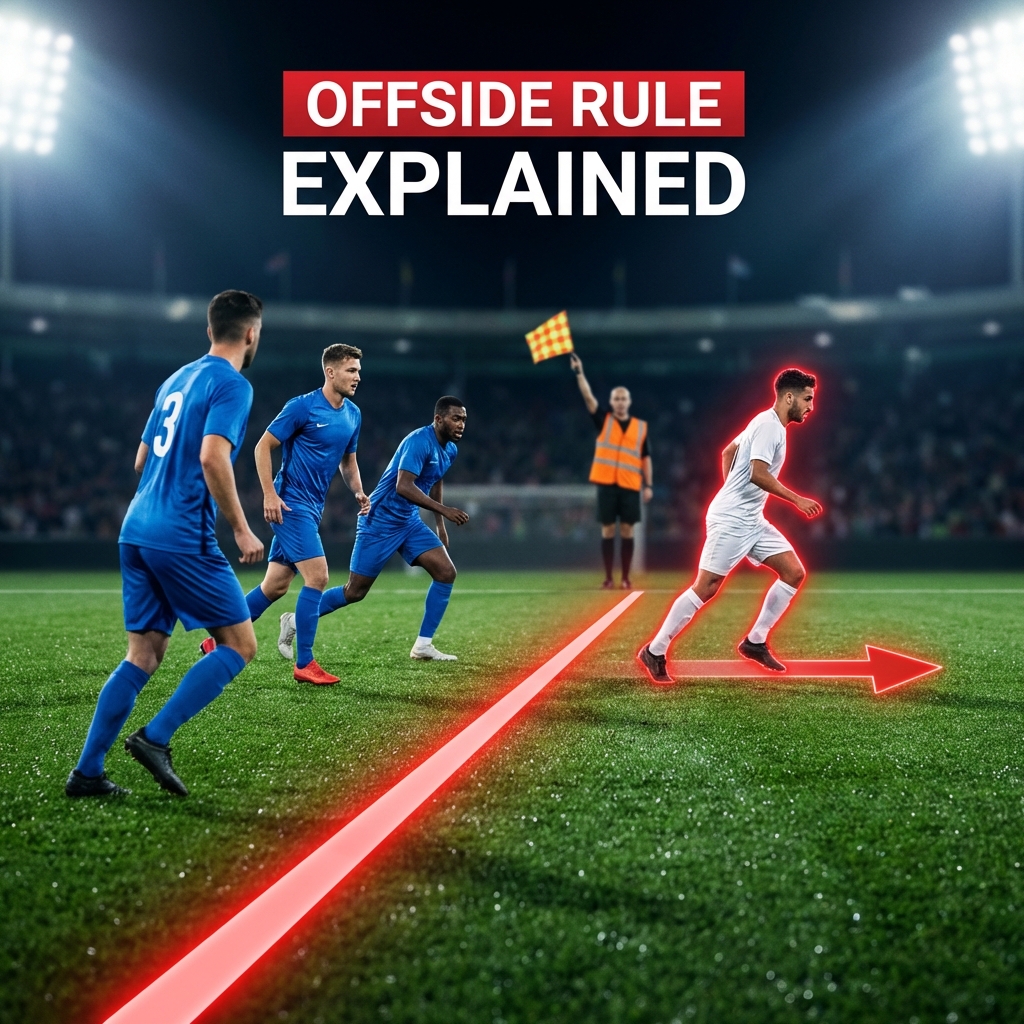
The Rule That Prevents "Goal Hanging"
If the offside rule didn't exist, football would be a very different game. Strikers would simply stand in front of the opposition goal and wait for long balls, while defenders would never leave their own penalty area. The offside rule is the law that forces the game to be played in the middle of the pitch, requiring strategy, timing, and skill rather than just "goal-hanging."
Despite its importance, it remains the most confusing and controversial rule for new fans and seasoned professionals alike.
The Basic Definition: Law 11
According to the FAO Law 11, a player is in an offside position if:
- Any part of their head, body, or feet is in the opponents' half (excluding the halfway line) AND
- Any part of their head, body, or feet is nearer to the opponents' goal line than both the ball and the second-to-last opponent.
Crucially: An "opponent" includes the goalkeeper. In 99% of cases, the goalkeeper is the last opponent, meaning the striker must be behind the last defender to be onside.
Position vs. Offense
Being in an offside position is not a foul in itself. A player is only penalized if they become "actively involved" in the play while in that position. This happens if they:
- Interfere with play by touching the ball passed by a teammate.
- Interfere with an opponent by preventing them from playing the ball (e.g., blocking the goalkeeper's vision).
- Gain an advantage by playing a ball that has rebounded off the post or the goalkeeper.
The History of the Rule
The offside rule has been changed many times to make the game more attacking.
- 1863: The original rule was like rugby—you couldn't pass the ball forward at all.
- 1925: The rule changed from needing three opponents between you and the goal to needing just two. This led to an immediate and massive increase in goals scored.
- 1990: The rule was changed to state that if a player is "level" with the second-to-last defender, they are onside. This gave the advantage back to the attacker.
The VAR Era: "Armpit" Offsides
Since 2019, the introduction of the Video Assistant Referee (VAR) has fundamentally changed how offside is policed. Previously, linesmen (assistant referees) had to make split-second decisions with the naked eye. They were encouraged to give the "benefit of the doubt" to the attacker.
With VAR, the process is mathematical. Digital lines are drawn on the screen, often measuring down to the millimeter. This has led to the controversial "armpit offside," where a goal is disallowed because a player's sleeve was a fraction of an inch beyond the defender. While it is technically "accurate," many argue it has removed the "spirit" of the game.
Tactical Innovation: The Offside Trap
The existence of the rule allows for the Offside Trap. This is a high-risk defensive tactic where the entire defensive line sprints forward right before an opponent passes the ball. If timed perfectly, it leaves the striker standing alone in an offside position.
Teams like AC Milan under Arrigo Sacchi and more recently Liverpool under Jürgen Klopp have mastered this, using it to squeeze the opposition into a tiny area of the pitch. However, if one defender is slow to move, the striker is left one-on-one with the goalkeeper.
Semi-Automated Offside Technology (SAOT)
To solve the slow and controversial VAR process, football is moving toward Semi-Automated Offside. Using 12 dedicated cameras around the stadium and a sensor inside the ball, the system can track 29 data points on each player 50 times per second. It can detect an offside position automatically in seconds, sending a 3D animation to the fans and the referee.
Conclusion
The offside rule is the foundation of football tactics. It is a game within a game—a constant battle of timing between the striker's run and the defender's positioning. While technology has made the calls more accurate, the debate over "marginal" decisions will never truly end. It is a law that is as much about geometry as it is about football, and it remains the most vital tool in the referee’s kit.
Share this guide
Use Data to Win
Now that you understand the stats, see them in action. Check out the best defensive teams in Europe right now.
View Defensive Stats