
Parking the Bus: The Art of the Low Block
The Origin of the Term
In 2004, after a 0-0 draw against Tottenham, José Mourinho complained that the opposition had "bought the bus and left the bus in front of the goal." While Mourinho intended it as an insult, ironically, he would go on to become the master of the very tactic he criticized.
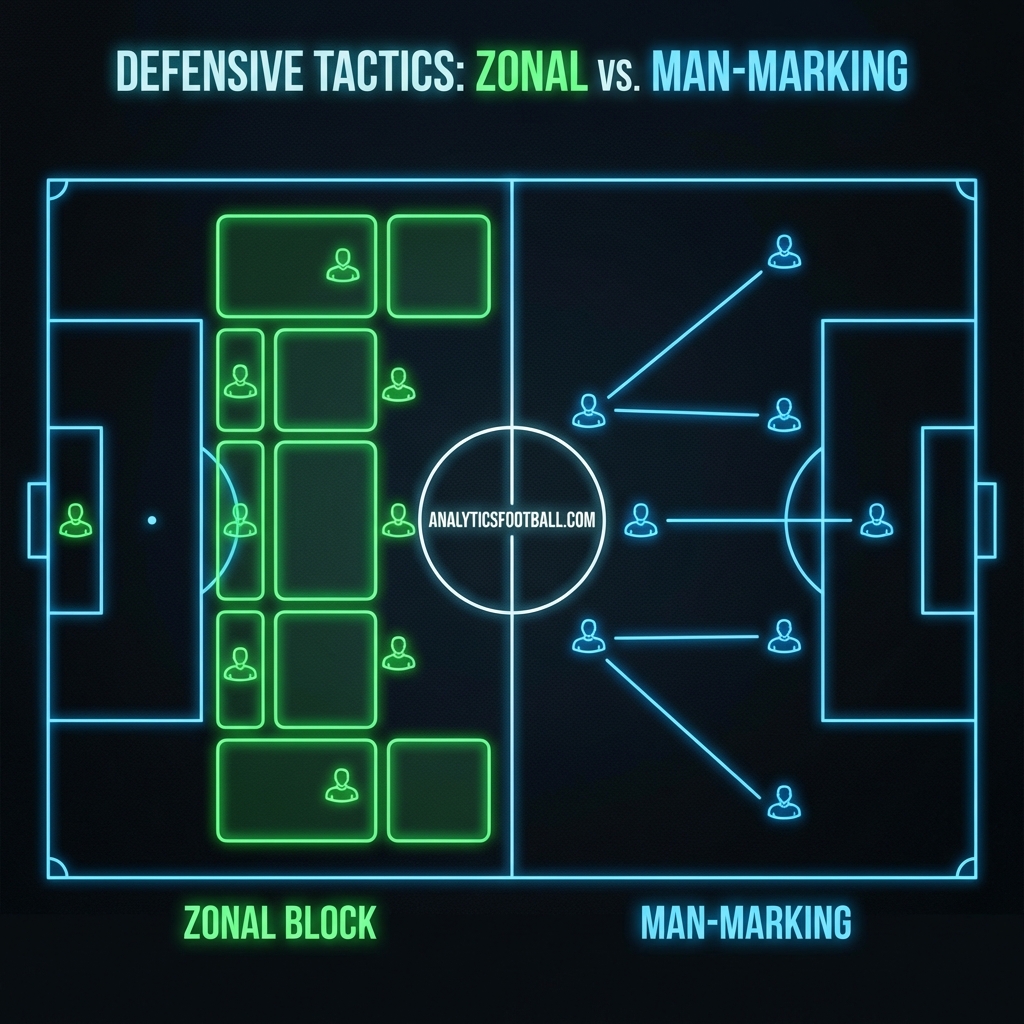
"Parking the Bus" (technically known as a Low Block) is the intentional strategy of sitting deep in your own half, minimizing the space between your defenders and your goalkeeper, and refusing to be drawn out of position.
Is It "Anti-Football"?
Critics often label the low block as "boring" or "anti-football" because it prioritizes stopping the opponent from playing rather than trying to score yourself. However, for a smaller team playing against a global giant, it is often the only logical way to survive.
Tactically, a perfectly executed low block is a masterpiece of concentration, discipline, and physical endurance. If one player loses focus for even a second, the "bus" breaks down and the opponent scores.
The Pillars of a Successful Low Block
- Horizontal and Vertical Compactness: The distance between the four defenders and the four midfielders must be tiny (often less than 10 meters). This makes it impossible for the opponent to play "between the lines."
- No "Depth" for the Opponent: By sitting so deep, you remove the space behind the defense. Faster strikers like Kylian Mbappé are neutralized because there is no room to run into.
- Zonal Discipline: Players are taught to "defend the space" rather than follow individual opponents. This prevents the defense from being pulled out of shape by decoy runs.
- The Out-Ball: Parking the bus only works if you have a way to relieve pressure. This usually requires a tall "target man" striker who can hold the ball up or an extremely fast winger for the counter-attack.
Famous "Bus Parking" Masterclasses
Inter Milan vs. Barcelona (2010)
Perhaps the most famous example. After having a player sent off early in the Champions League semi-final, Mourinho’s Inter Milan produced a legendary defensive performance. They enjoyed only 19% possession but managed to stop Lionel Messi and Co., eventually winning the trophy.
Chelsea vs. Barcelona & Bayern (2012)
In their run to their first Champions League title, Chelsea twice used a deep-sitting low block to survive against teams with far more technical quality. It proved that in knockout football, survival is more important than style.
Atletico Madrid under Diego Simeone
For over a decade, Simeone has turned the low block into a cultural identity. Atletico fans don't just tolerate defensive football; they celebrate it. Their ability to "suffer" together has allowed them to compete with the financial might of Real Madrid and Barcelona.
How Do You Break a Bus?
For attacking teams, a low block is a frustrating puzzle. The common solutions include:
- Overloading the Wings: Using fullbacks to create 2-vs-1 situations on the flank to find a crossing angle.
- Long-Range Shooting: Forcing the defense to step out of their block to block a shot, which creates gaps behind them.
- Set Pieces: When you can't play through a team, you must rely on corners and free-kicks.
Conclusion
Parking the bus might not be pretty, but it is an essential part of the tactical tapestry of football. it is the ultimate equalizer, allowing the underdog to dream of a result against the giant. In a sport defined by results, there is no "wrong" way to win—there is only the most effective way.
Share this guide
Use Data to Win
Now that you understand the stats, see them in action. Check out the best defensive teams in Europe right now.
View Defensive Stats