
Beyond the Shot: Understanding xGChain and Building Models
The Limitation of Standard xG
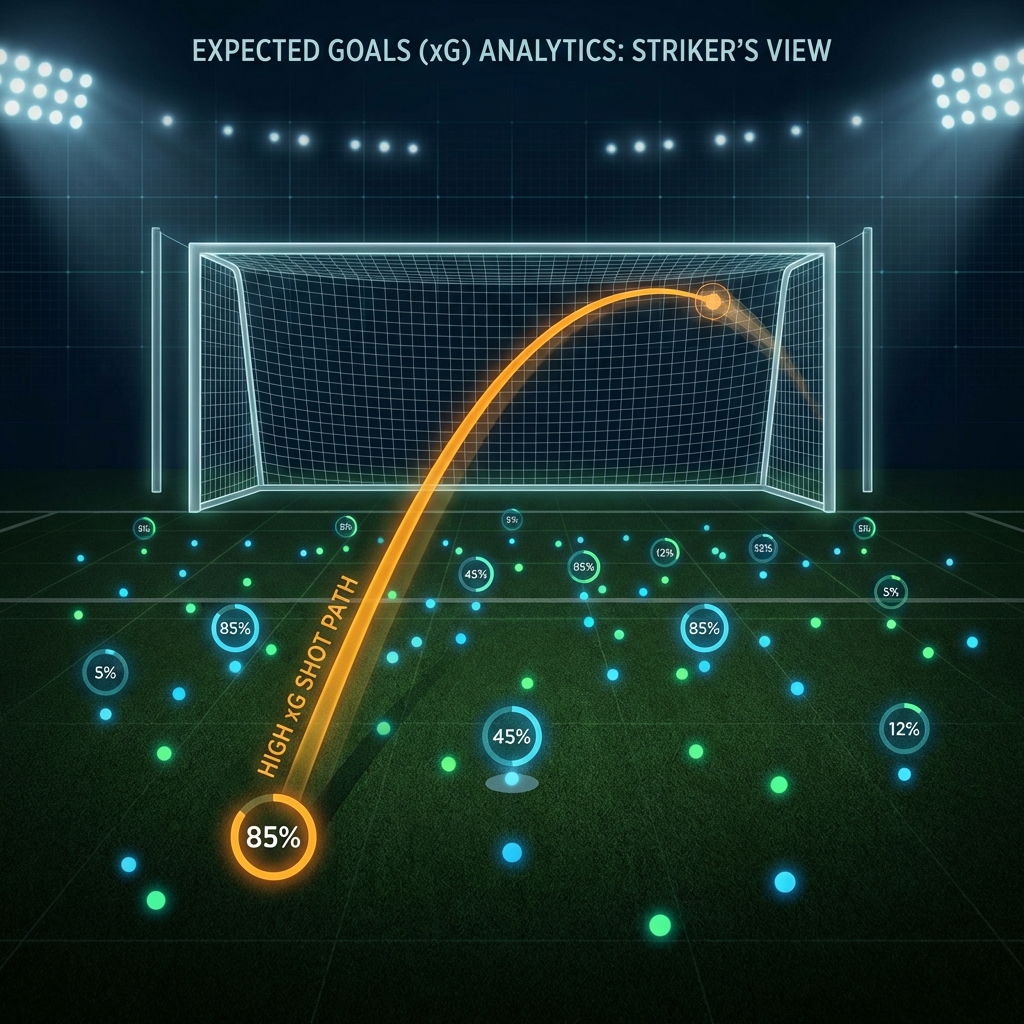
By now, most fans understand Expected Goals (xG). It measures the quality of a shot. But football is a team game, and a goal is often the result of a long sequence of passes involving multiple players.
A standard xG stat only rewards the player who takes the shot and the player who provides the assist. But what about the defensive midfielder who won the ball back? Or the center-back who played a perfect 40-yard pass to start the attack? To reward these players, we use xGChain.
What is xGChain?
xGChain is a metric that assigns the full xG value of a shot to every player involved in the possession sequence that led to that shot.
Why is this useful?
Imagine a possession that leads to a high-quality shot worth 0.80 xG:
- Player A (CM) wins a tackle and passes to Player B.
- Player B (Winger) dribbles past two players and passes to Player C.
- Player C (Fullback) crosses the ball to Player D.
- Player D (Striker) takes a shot.
In traditional stats, only Player C (the assist) and Player D (the shot) get credit. In xGChain, every player (A, B, C, and D) is credited with 0.80 xGChain. This allows us to identify players who are vital to their team's attacking flow, even if they aren't the ones scoring.
What is xGBuildup?
xGBuildup is a variation of xGChain that excludes the person who took the shot and the person who provided the assist.
This metric is specifically designed to highlight deep-lying playmakers and "unsung heroes." It tells us: "Who is helping the team create chances without being directly involved in the final touch?"
Players like Rodri (Manchester City) or Toni Kroos (Real Madrid) often rank at the top of xGBuildup charts. They are the "conductors" of the orchestra, and xGBuildup is the only way to scientifically prove their value.
Why Should You Care?
For the modern fan or fantasy football player, these stats are "leading indicators" of future success.
- Identifying Hidden Gems: If a winger has low goals and assists but high xGChain, it suggests they are heavily involved in their team's best moves and that the goals will eventually come.
- Evaluating Midfielders: It is the best tool for comparing two central midfielders. One might have more goals, but the other might have a much higher xGBuildup, suggesting they are more important to the team's overall dominance.
Interpreting the Data on Format
When looking at player profiles on Format, you can use these metrics to spot trends. A team with high xGChain distributed across the midfield is usually a "possession-based" side that builds attacks through intricate passing. A team where xGChain is concentrated in just two players is likely a "counter-attacking" side that relies on individual brilliance.
Conclusion
Football is too complex to be reduced to just goals and assists. Metrics like xGChain and xGBuildup allow us to see the "hidden contribution" of every player on the pitch. They turn the spotlight away from the goal-scorers and onto the architects, proving once and for all that while the striker wins the game, the team builds the victories.
Share this guide
Use Data to Win
Now that you understand the stats, see them in action. Check out the best defensive teams in Europe right now.
View Defensive Stats