
Modern Football Tactics: Zonal vs. Man-Marking Explained
The Eternal Defensive Dilemma
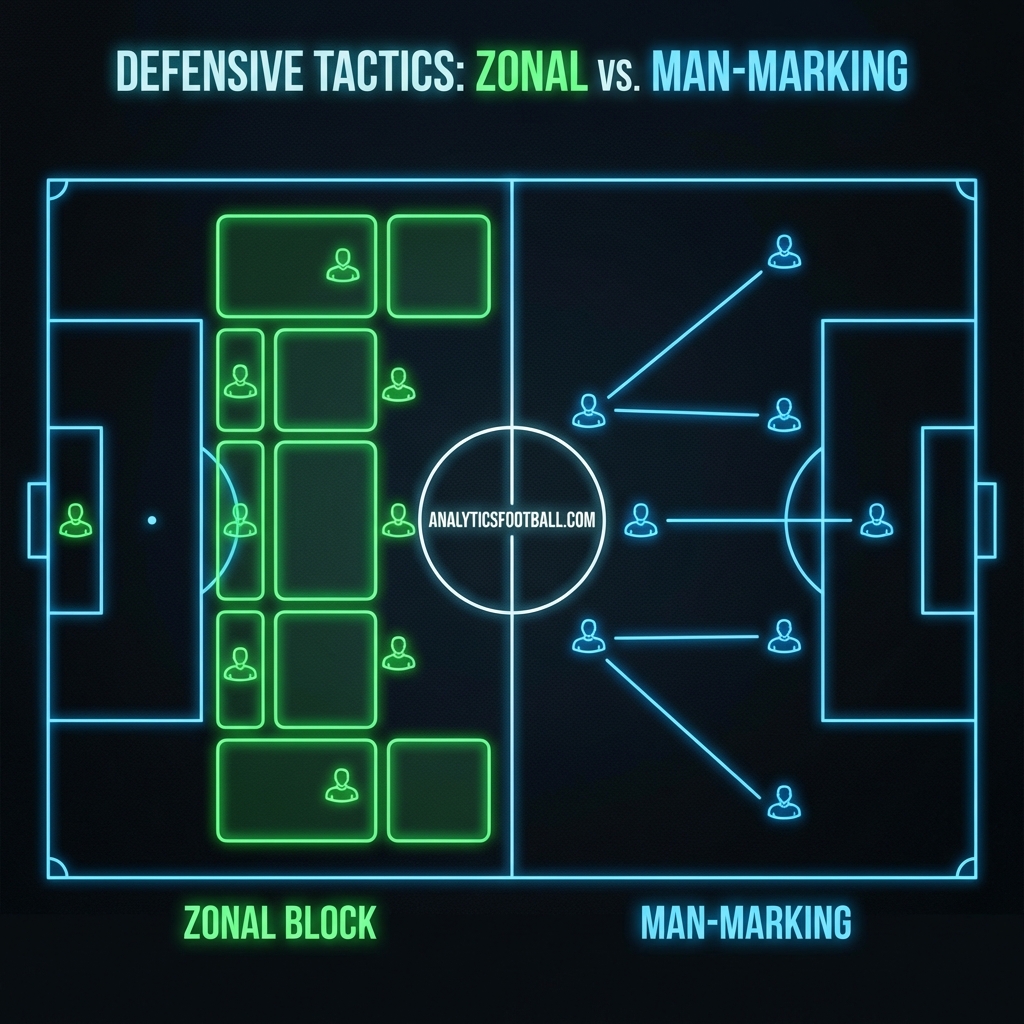
In football, defense is often described as the art of making the pitch as small as possible for the opponent. To achieve this, managers must decide on a fundamental philosophy: do my defenders follow the players, or do they guard the space?
This is the core difference between Man-Marking and Zonal Marking. While the game has evolved toward complex hybrids, understanding these two pillars is essential for any fan wanting to analyze a match like a pro.
What is Man-Marking?
Man-marking is the oldest and most straightforward defensive strategy. In this system, each defensive player is assigned a specific opponent to follow whenever the team is out of possession.
How it Works:
If you are a right-back assigned to mark the opposing left-winger, your job is to stay within touching distance of that player. If they move to the center, you follow. If they drop deep to collect the ball, you go with them.
Pros:
- Clear Responsibility: Every defender knows exactly who they are responsible for. There is no confusion about "whose man" it was if a goal is conceded.
- Eliminates Time and Space: High-intensity man-marking (like that used by Marcelo Bielsa or Gian Piero Gasperini) can suffocate an opponent, preventing them from ever turning with the ball.
Cons:
- Manipulated Shape: A clever attacker can intentionally run into "wrong" areas of the pitch, dragging a defender out of position and creating a massive hole in the defensive line.
- One-on-One Risk: If one defender loses their individual duel, the entire system can collapse as there is no "safety net" in the space behind them.
What is Zonal Marking?
Zonal marking shifted the focus from the individual to the collective. Instead of following a specific player, defenders are responsible for a particular zone of the pitch.
How it Works:
The team moves as a single unit (often described as being "connected by an invisible string"). If the ball is on the right, the entire team shifts right to limit space. Defenders only engage attackers who enter their specific area.
Pros:
- Maintains Team Shape: The defense remains compact and difficult to play through, regardless of where the attackers move.
- Superior for Interceptions: Because defenders are watching the ball and the space rather than just their "man," they are better positioned to cut out passing lanes.
Cons:
- Overloading: Two or three attackers can "overload" a single zone, forcing one defender to choose between multiple threats.
- Mental Focus: It requires elite communication and concentration. If one player fails to shift with the unit, the "zone" is broken.
Set-Piece Marking: The Hybrid Approach
The debate between Zonal and Man-Marking is most heated during corners and free-kicks. You will often hear commentators criticize "Zonal Marking" whenever a team concedes from a corner, but the reality is more nuanced.
Most modern elite teams use a Hybrid System:
- Zonal Blockers: 3-4 players are stationed in the "danger zone" (the six-yard box) to attack any ball that comes into that space.
- Man-Markers: 3-4 players stay "goal-side" of the opponent’s best headers (the tall center-backs) to disrupt their movement.
This combines the structural strength of Zonal marking with the physical disruption of Man-marking.
Conclusion: Which is Better?
In the modern era, Zonal Marking is the dominant philosophy for open-play defending. It allows teams to press effectively and maintain a high defensive line. However, elements of man-marking are still used "within the zone" when an attacker becomes an immediate goal-scoring threat.
The next time you watch a match on Format11, look at the defensive line when the opponent has the ball. Are they shifting as a block? Or is the center-back following the striker all the way to the halfway line? Now you’ll know exactly what the manager is trying to achieve.
Want to learn more about the stats behind the defense? Check out our Best Defensive Leagues page to see which tactical systems are conceding the fewest goals this season.
Share this guide
Use Data to Win
Now that you understand the stats, see them in action. Check out the best defensive teams in Europe right now.
View Defensive Stats